Read more here.She sat in the co-pilot’s seat with the pilot beside her, and I relayed to her his instructions.The plane crew were amazed at her sensitive touch on the controls. There was no shaking or vibration. She just sat there and flew the plane calmly and steadily.
Showing posts with label History. Show all posts
Showing posts with label History. Show all posts
Tuesday, June 1, 2021
Helen Keller once flew an airplane!
It was 75 years ago, during June of 1946 that deaf-blind disability rights advocate Helen Keller flew a plane. The story is recorded in a newspaper article archived by the American Foundation for the Blind. She piloted the airplane for 20 minutes as it flew over the Mediterranean ocean. Her companion, Polly Thomson, is recorded as saying:


Tuesday, March 16, 2021
The first Network TV Captioning
On March 16, 1980—41 years ago today—that the network TV channels ABC, NBC and PBS debuted closed-captioned television shows, in which the show’s dialogue and soundtrack appeared as text on-screen as the action proceeded. The first shows to be aired with captioning were The ABC Sunday Night Movie, Disney’s Wonderful World and Masterpiece Theatre.
Tuesday, September 29, 2020
On this date... 29 years ago

Sunday, September 27, 2020
20 years ago today: Murder at Gallaudet
 It was on this day (Sept 27) in 2000 that Joseph Mesa, Jr. beat Eric Plunkett to death in his Gallaudet dorm room. The killing put the school in a state of panic, with some students withdrawing from the school rather than living in a situation where they knew a murderer was living among them. The terror came to an end in February of the next year when Mesa turned himself into police-but not before he killed again. Mesa stabbed Benjamin Varner in his Gallaudet dorm room more than a dozen times. In July of 2002, the 22-year-old from Guam pleaded not guilty by reason of insanity, telling jurors he saw hands wearing black gloves that told him in sign language to kill. Jurors convicted Mesa on all counts and a Washington, DC judge sentenced him to six life terms without the possibility of parole. Mesa began serving time at the United States Penitentiary in Atwater, California near San Francisco, a high-security facility.
Thursday, September 17, 2020
On this day in History.. the first deaf Miss America
On this date (Sept. 17) in 1994, Heather Whitestone of Alabama became the first deaf Miss America.
History's Deaf Astronomer
 On this date (Sept 17) in 1764, John Goodricke was born in the Netherlands, though he lived most of his life in England. Goodricke only survived to the age of 21, but the deaf astronomer made a major impact on his field. Working with Edward Pigott, Goodricke learned to measure the variation of light coming from stars. This would eventually lead astronomers to figure out the distance of galaxies from the earth. While still a teenager, the Royal Society of London gave him the Copley Medal, making him the youngest person to be given its highest honor. Goodricke lost his hearing after a bout with a childhood disease, which might have been scarlet fever. He studied at the first school for deaf children in the British Isles, Thomas Braidwood’s Academy for the Deaf and Dumb in Edinburgh. Goodricke went on to study for three years at the Warrington Academy.
Sunday, August 2, 2020
A drama based on DPN!
A drama is planned based on the book  Deaf President Now! The 1988 Revolution at Gallaudet University. The book, written by John Christiansen and Sharon Barnartt, tells the story of what happened the week of protests at Gallaudet when the students and supporters rallied for eight days around the cry for the school to have a deaf president. The untitled show is an effort from Concordia Studio backed by Nyle DiMarco.

Sunday, July 12, 2020
How the 1918 influenza pandemic affected the Kentucky School for the Deaf

Monday, July 6, 2020
How Rochester Became a Hub for the Deaf
Rochester is home to one of the largest deaf and hard-of-hearing populations in the U.S. Read about how that came about in an article from the Daily Beast here.
Tuesday, June 2, 2020
More than 110 years ago
Here is a bit of history. The paragraph below as published in the June 1907 issue of Scientific American magazine—more than 110 years ago:
The loss of the sense of hearing should not necessarily mean deprivation of the power of speech. Is it only within recent years that we have come to realize this fact, and in up-to-date institutions the old –fashioned finger alphabet is now unknown. Every child is taught to speak in the natural way by means of the vocal organs. The four or five years of the primary course are devoted almost exclusively to the acquirement of language and numbers.
Tuesday, March 17, 2020
How Deaf Advocates Won the Battle for Closed Captioning
"It wasn’t until March 16, 1980 — 40 years ago this Monday — that the network TV channels ABC, NBC and PBS debuted closed-captioned television shows, in which the show’s dialogue and soundtrack appeared as text on-screen as the action proceeded..But getting there was a fight, and that battle still continues today." Read more about the battle for closed captioning from TIME magazine here.
Monday, February 3, 2020
How 11 Deaf Men Helped NASA Leave Earth
Why were 11 deaf men selected by NASA to help it understand space sickness? The key here was how each of these men lost their hearing, according to Discover Magazine. These men ultimately played a significant role in getting the first astronauts off the ground in the 1960s.
Saturday, February 1, 2020
Was Beethoven HoH instead of Deaf?
Kent State researchers say Ludwig van Beethoven was not completely deaf as is commonly believed. The theory is that "the composer still had hearing in his left ear until shortly before his death in 1827. Theodore Albrecht, professor of musicology at Kent State University, told the Observer:
Not only was Beethoven not completely deaf at the premiere of his Ninth Symphony in May 1824, he could hear, although increasingly faintly, for at least two years afterwards, probably through the last premiere that he would supervise, his String Quartet in B-flat, Op 130, in March 1826.Read more here.
Friday, November 15, 2019
Historic marker unveiled for Rochester’s School for the Deaf
A roadside marker was unveiled yesterday to honor the role of Rochester’s School for the Deaf in the community. The school was established in 1876. RochesterFirst.com has a video report (or read the story here).
Sunday, September 15, 2019
The Rise of the Deaf Architecture
It was on the campus of Gallaudet University nearly two decades ago that a workshop took place that would "change the way the world’s only university for the deaf and hard-of-hearing engaged with architecture and design." The Washington Post has a look at how the deaf architecture got started here.
Monday, November 5, 2018
Kitty O'Neil Dies

Childhood diseases left her deaf and nearly killed her. She became a champion diver at a young age. Her work later as a Hollywood stuntwoman was featured in TV shows like Quincy, Baretta and The Bionic Woman along with movies like Smokey and the Bandit, The Blues Brothers and Airport '77.
She set a record for the highest stunt fall by a woman (105 feet). She has held as many as 22 speed records on land and water.
A movie was made about her life in 1979 titled Silent Victory: The Kitty O'Neil Story. She died Nov. 2, 2018 from pneumonia. Read more about her amazing life in a Washington Post article here.
Wednesday, July 4, 2018
The deaf protest that gripped America
The BBC has a new video explaining what happened at Gallaudet University in 1988 when a protest started over the appointment of a new president. The network interviewed I King Jordan, the first ever deaf President of Gallaudet University.
Sunday, June 24, 2018
A New, Vast Helen Keller Archive
 The American Foundation for the Blind has launched the world’s first fully accessible digital archive collection of Helen Keller artifacts. The collection includes digitized letters, essays, speeches, and more than a quarter million digital images of her work. You can access the archive here.
Wednesday, April 11, 2018
How 'Deaf President Now' Changed America
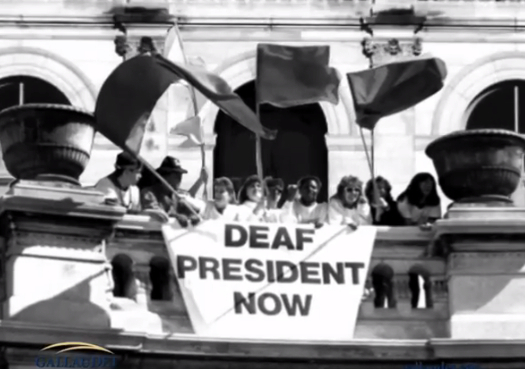 "Deaf President Now stands as a watershed moment in the history not just of Deaf and disability rights, but also of American civil rights more broadly. As I spoke to people who had been instrumental in the protests, and the current president of Gallaudet, I heard one additional message: a fear that too few Americans even remember this story," writes University of Minnesota history professor David Perry. He has put together a "A brief history of the movement that transformed a university and helped catalyze the Americans With Disabilities Act." You can read the entire article here.
.
Wednesday, April 4, 2018
Gallaudet: 30 years after 'Deaf President Now' protest
It has been three decades since students at Gallaudent University "brought the campus in the nation's capital to a standstill 30 years ago during a week-long protest to demand a 'deaf president now.'" USA Today has a look back and how it happened and a look at how students look at the movement today. The newspaper quotes Ryan Maliszewski, who runs Gallaudet's Innovation and Entrepreneurship Institute, as saying, "Students today don't need wait for another protest like 1988 to create opportunities for leadership in the deaf community." Read the full story here.
Subscribe to:
Posts (Atom)